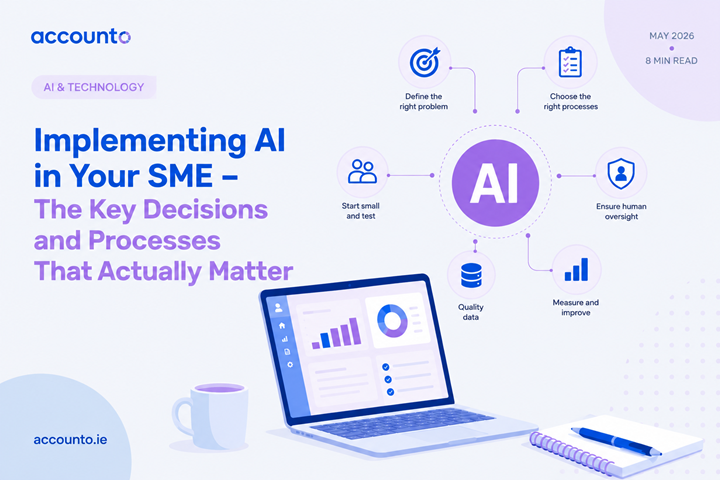
Implementing AI in Your SME — The Key Decisions and Processes That Actually Matter
AI can save SMEs significant time and money. But getting the implementation right matters. Here are the key decisions every small business should work through before going live.
Most conversations about AI and small business fall into one of two camps.
The first is breathless enthusiasm — AI will transform everything, automate every process, and revolutionise how the business operates. The second is dismissal — it’s too complicated, too expensive, and built for larger organisations with dedicated technology teams.
Neither is particularly useful for a small business owner trying to make a practical decision about where to start.
The reality is more straightforward. AI is genuinely useful for SMEs in specific, well-defined applications. The businesses getting value from it aren’t necessarily the most sophisticated or the best resourced. They’re the ones that made a few good decisions at the outset and implemented it thoughtfully rather than reactively.
Here’s what those decisions look like in practice.
Start with the problem, not the technology
The single most common mistake in AI implementation is starting with a tool rather than a problem.
A new AI platform gets introduced because it looks impressive, or a competitor is using it, or someone read an article about it. The team spends time learning it. Processes get adjusted around it. And six months later the honest assessment is that it hasn’t changed very much.
The businesses that get genuine value from AI start from the other direction. They identify the specific processes that are consuming disproportionate time, producing inconsistent results, or creating bottlenecks — and then ask whether AI can help with those specifically.
That’s a very different question to “what can we use AI for?” It’s disciplined rather than exploratory. And it produces a much clearer brief for what good implementation actually looks like.
Be honest about what AI can and can’t do
Before implementing anything, it’s worth being clear-eyed about where AI genuinely helps and where it doesn’t.
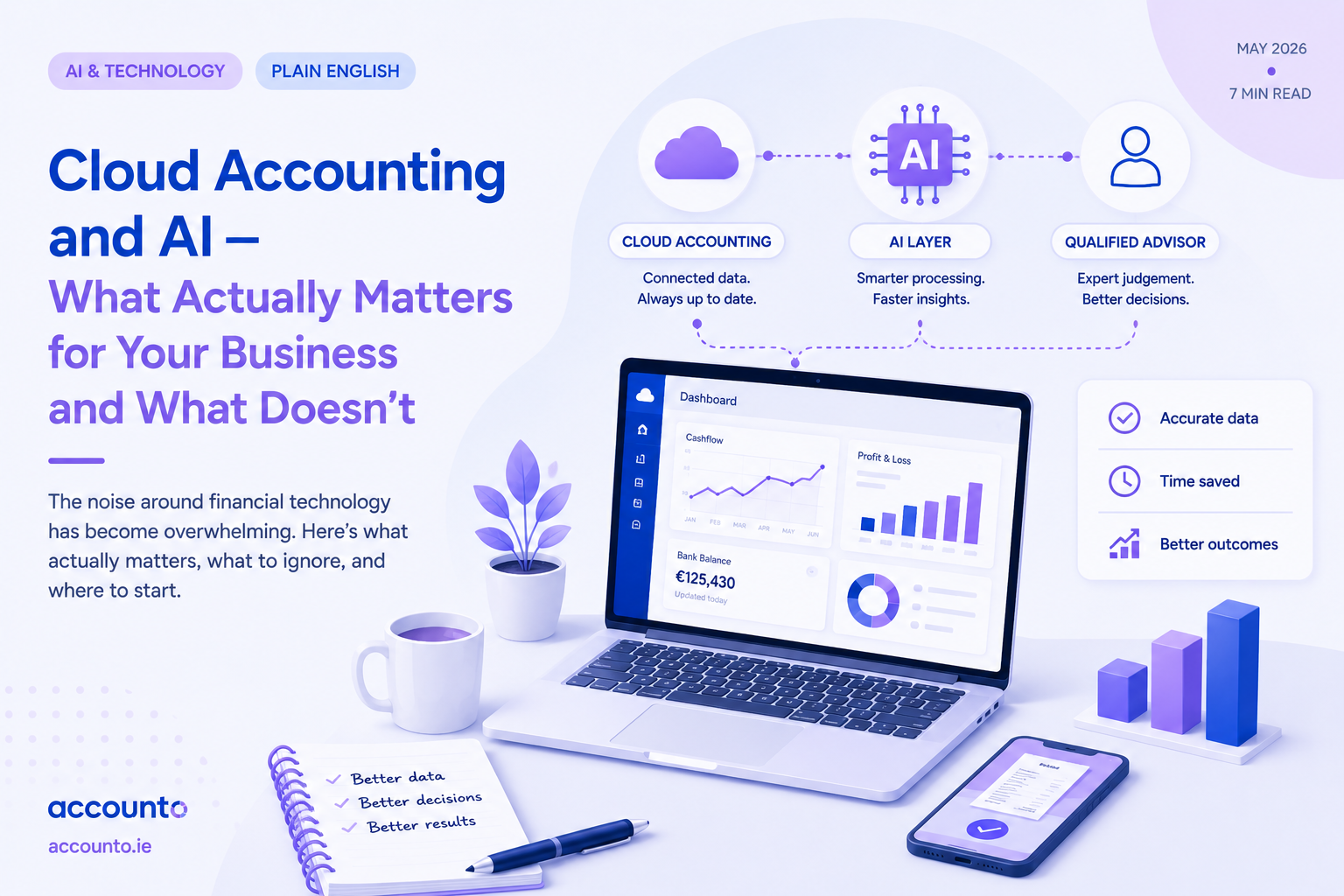
AI is very good at tasks that are repetitive, high-volume, and language or pattern-based. Drafting documents, summarising information, extracting data from unstructured sources, generating first-draft content, categorising transactions, spotting anomalies in datasets. These are tasks where AI can replace hours of manual work with seconds of processing — and do it consistently, without fatigue or error.
AI is not good at tasks that require genuine human judgement, contextual knowledge, or accountability. Strategic decisions, relationship management, nuanced advice, and anything where being wrong has significant consequences — these still require a human. Not because AI can’t produce an output, but because that output needs to be verified, contextualised, and owned by someone qualified to do so.
The most effective implementations keep this distinction clear. AI handles the volume work. Humans handle the judgement. Confusing the two — either by over-relying on AI for decisions it shouldn’t be making, or by refusing to use it for tasks it handles better than any person — is where most implementations go wrong.
Decide on the human oversight model before going live
This is the decision that most SMEs skip — and the one that matters most.
Before any AI tool goes live in a business process, the question of human oversight needs to be answered explicitly. Who reviews the output before it reaches a client, a customer, or a decision-maker? What’s the quality check? What happens when the AI gets it wrong?
These aren’t hypothetical questions. AI makes mistakes. It misreads context. It produces outputs that are plausible but incorrect. In low-stakes applications this is a minor inconvenience. In professional services, finance, legal, or medical contexts, it can be a serious problem.
The answer isn’t to avoid AI. It’s to build the oversight into the process from the start. A mandatory human checkpoint before any AI output reaches the outside world isn’t a limitation on the technology — it’s what responsible and effective implementation looks like.
Run a small pilot before committing to a full rollout
The temptation when implementing something new is to do it properly — full rollout, full training, full commitment. This is usually a mistake with AI.
The more effective approach is to run a small, contained pilot first. Pick one process. Implement one tool. Measure the output honestly over four to six weeks. Ask the people using it what’s working and what isn’t. Then make a considered decision about whether and how to scale.
This approach costs less, creates less disruption, and produces much better information about whether the tool is actually delivering value. It also makes it significantly easier to course-correct if the implementation isn’t working as expected.
Think about data before thinking about tools
AI tools are only as useful as the data they have access to. This is a practical consideration that gets overlooked more often than it should be.
Before implementing any AI system that draws on business data — financial data, customer data, operational data — it’s worth asking a few basic questions. Is the data clean and consistent? Is it stored in a format the tool can actually use? Are there gaps or errors that would produce unreliable outputs?
For most SMEs, the honest answer is that the data is messier than they’d like. Inconsistent formatting, missing records, data spread across multiple systems that don’t talk to each other. Spending time tidying the data foundation before going live with AI isn’t glamorous work, but it’s what separates implementations that deliver consistent value from those that produce unreliable outputs and create more work than they save.
Get the team on board early
AI implementation in a small business fails more often because of people than because of technology.
When a new tool is introduced without adequate explanation, people don’t understand why it’s there, what it’s supposed to do, or how their role relates to it. In the absence of clear communication, assumptions fill the gap — often unhelpful ones. Some people assume the tool is there to replace them. Others ignore it entirely. Neither is the intended outcome.
The fix is straightforward but requires deliberate effort. Explain the purpose clearly before launch. Be specific about what the tool will do, what it won’t do, and what changes for the people using it. Involve the team in the pilot phase. Make it clear that human expertise remains central — the tool is there to handle the time-consuming parts, not to replace the judgement that makes the output valuable.
Measure what changes — and be honest if it isn’t working
Any AI implementation should come with a clear before-and-after measurement. Not a vague sense that things have improved — a specific comparison of the time, cost, or quality of output before and after the tool was introduced.
This serves two purposes. It validates the investment and makes the case for scaling. And it creates the conditions for an honest conversation if the implementation isn’t delivering what was expected.
The willingness to acknowledge that a particular tool isn’t working, and to make changes accordingly, is one of the most important characteristics of effective AI implementation. Sunk cost thinking — continuing with something because of the time already invested — is as costly in technology as it is anywhere else.
The financial dimension
There is one area where AI implementation deserves particular care in any SME — and that’s anything touching financial processes.
AI can add genuine value in financial reporting, management accounts commentary, cashflow forecasting, anomaly detection, and automated data extraction. These are well-defined, high-volume tasks where the technology performs consistently well.
But financial AI output needs a qualified human in the loop before it informs any decision or reaches any external party. The technology produces a first draft. The expert reviews, contextualises, and approves. That combination — AI efficiency with human accountability — is what responsible financial AI looks like in practice.
The businesses that get this right don’t use AI to replace financial expertise. They use it to make financial expertise more efficient, more consistent, and more accessible than it would otherwise be.
THE BOTTOM LINEAI is worth implementing in most SMEs. But the businesses that get genuine value from it aren’t the ones that move fastest or adopt the most tools. They’re the ones that start with a clear problem, build human oversight into the process from the beginning, and measure the results honestly.
That’s not a particularly exciting formula. But it’s the one that works.
Thinking about how AI could work in your business? We’re always happy to have a straightforward conversation about where it adds value and where it doesn’t.
Book a free 30-minute call at accounto.ie or get in touch at hello@accounto.ie