Business Finance Options Explained — How to Choose the Right One
From bank loans to invoice finance to equity — a plain English guide to the main business finance options and how to know which one is right for your situation.
Most business owners approach financing the wrong way around.
They decide they need money. They think about where to get it. They approach a lender or investor. And then they discover — often at an inconvenient moment — that their financial position isn’t as presentable as they thought, or that the type of finance they’ve chosen doesn’t actually suit what they need it for.
Understanding the main business finance options isn’t complicated. But understanding which one is right for a specific situation — and what needs to be in place before approaching any source of finance — is where most businesses get it wrong.
The main types of business finance
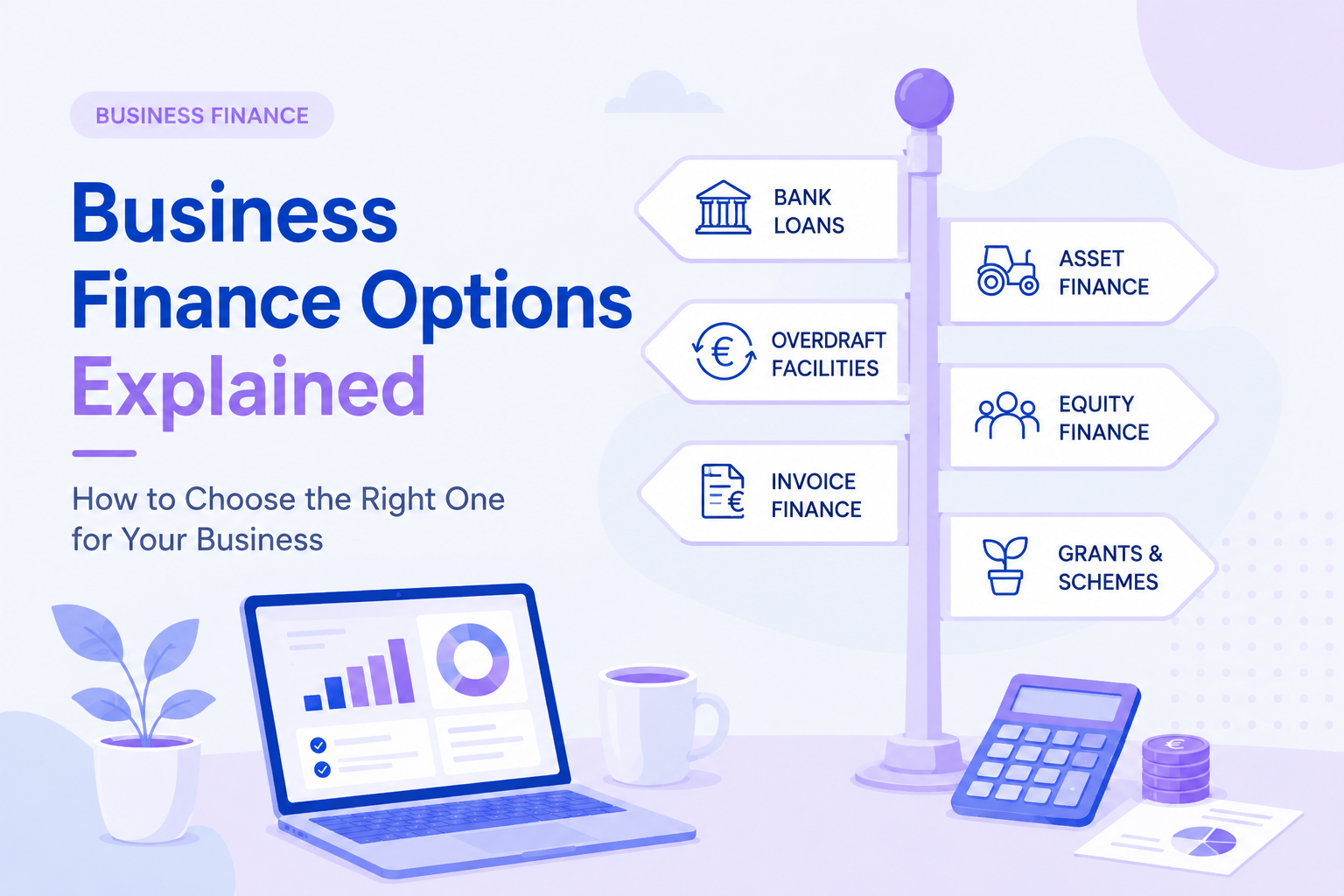
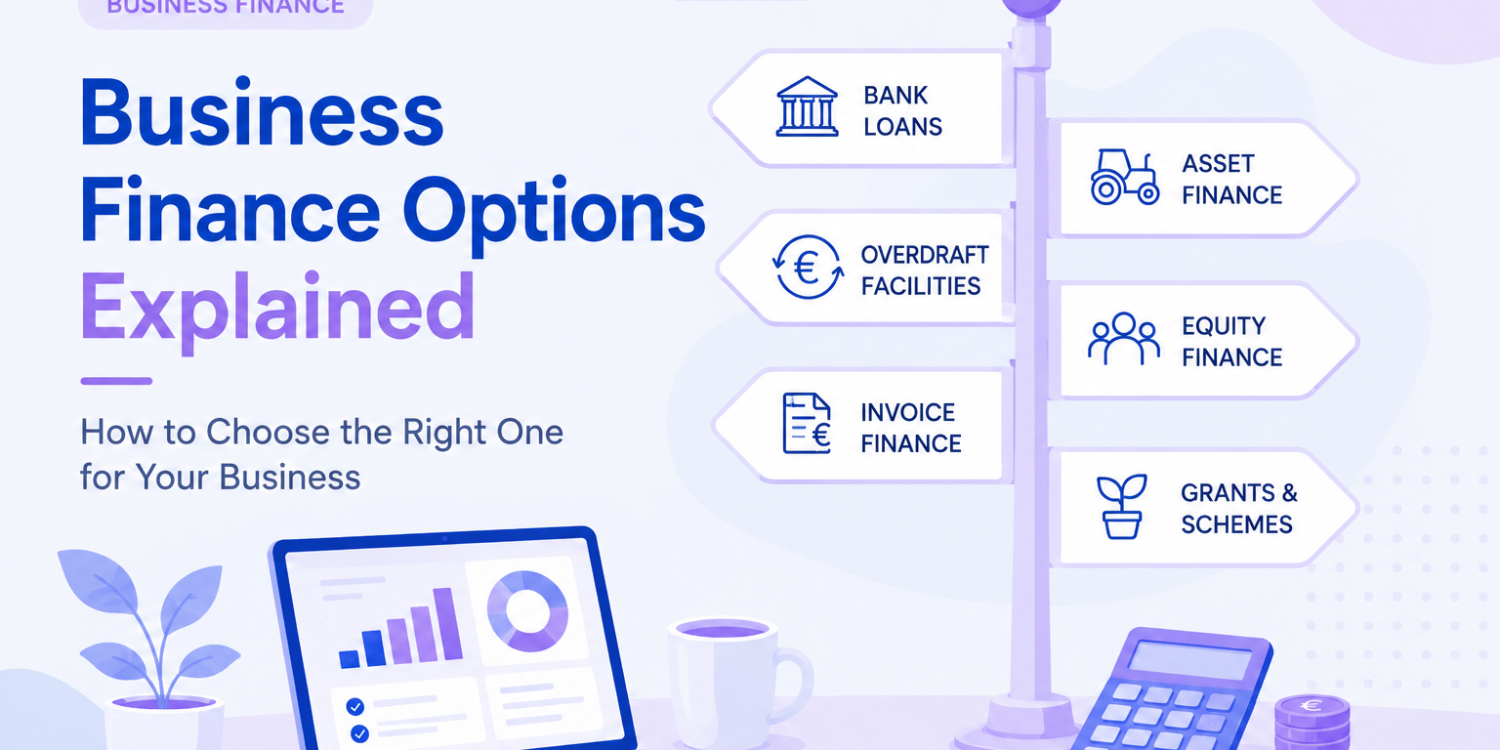
There are broadly six categories of business finance available to most SMEs. Each suits a different situation, a different stage of business, and a different risk profile.
01. Bank Loans
A bank loan is the most familiar form of business finance. The business borrows a fixed amount, repays it over an agreed term with interest, and the bank takes security — usually a personal guarantee from the directors, a charge over assets, or both.
Bank loans suit capital investment with a clear, defined purpose — buying equipment, fitting out premises, funding a specific project. They’re less suited to working capital needs or situations where the repayment schedule needs to flex.
What banks want to see before lending is straightforward: two to three years of audited or management accounts, a clear explanation of what the money is for, evidence that the business can service the debt from its cashflow, and usually some form of security. The businesses that struggle to access bank lending are almost always the ones whose financial records don’t clearly demonstrate repayment capacity — not necessarily because the capacity isn’t there, but because it isn’t visible in the numbers.
✓ Best for: capital investment with a defined purpose
02. Overdraft Facilities
A bank overdraft is a short-term revolving credit facility — the business can draw down and repay repeatedly up to an agreed limit. It’s designed for short-term cashflow gaps rather than longer-term funding needs.
Overdrafts are useful for managing timing differences — paying suppliers before customers pay, covering seasonal troughs, bridging a short-term gap. They’re expensive as a long-term funding tool and banks can withdraw or reduce them with relatively short notice, which makes them unsuitable as the primary source of working capital for a growing business.
✓ Best for: short-term cashflow timing gaps
03. Invoice Finance
Invoice finance allows a business to release cash tied up in unpaid invoices — typically between 70% and 90% of the invoice value — before the customer actually pays. The finance provider advances the cash and collects the debt directly or releases the balance when the customer pays, minus their fee.
This is one of the most underused forms of finance for SMEs with slow-paying customers. A business that invoices €50,000 per month on 60-day terms has €100,000 of cash permanently tied up in debtors. Invoice finance releases that cash immediately and removes the working capital constraint that slow payment creates.
It costs more than a bank loan but solves a different problem — it’s not about funding capital investment, it’s about accelerating the cash cycle.
✓ Best for: businesses with slow-paying customers and large debtor books
04. Asset Finance
Asset finance covers equipment leasing, hire purchase, and similar arrangements where the finance is secured specifically against the asset being purchased. Rather than paying for a piece of equipment outright or borrowing unsecured, the business finances the asset over its useful life and the lender retains an interest in the asset until it’s paid off.
For businesses that regularly invest in equipment, vehicles, or machinery, asset finance is often more efficient than a general bank loan — the security is the asset itself, the repayment term matches the useful life, and the cashflow impact is spread over time rather than concentrated at the point of purchase.
✓ Best for: equipment, vehicles, and machinery investment
05. Equity Finance
Equity finance means selling a share of the business in exchange for investment. Rather than repaying a loan, the investor takes a stake and shares in the future value of the business.
Equity is appropriate for businesses with high growth potential that need significant capital to scale — typically technology companies, early-stage businesses with a scalable model, or businesses pursuing rapid expansion that debt financing couldn’t support.
The trade-off is significant. Equity investors expect a return that reflects the risk they’re taking — typically a multiple of their investment on exit. Taking on equity investors also means sharing control and decision-making to a degree that varies by investor and deal structure.
Equity is not the right tool for most stable, profitable SMEs. It’s designed for businesses where the growth opportunity is large enough to justify giving away a portion of the future value of the business to access the capital to pursue it.
✓ Best for: high-growth businesses requiring significant scale capital
06. Grants and Government-Backed Schemes
Enterprise Ireland, Local Enterprise Offices, and the SBCI all offer grant funding, subsidised loans, and loan guarantee schemes specifically for SMEs. These are genuinely useful sources of capital that many businesses either don’t know about or don’t pursue because the application process feels daunting.
SBCI loans through participating banks offer lower interest rates and more flexible terms than standard commercial lending. Enterprise Ireland funding is available for businesses with genuine export potential. LEO grants support early-stage businesses and specific capital projects.
The limitation is that grant funding takes time, comes with conditions attached, and isn’t available for every purpose. It should be part of the financing toolkit rather than the primary strategy.
✓ Best for: eligible projects, early-stage businesses, export-focused growth
How to choose the right option
The type of finance that’s right for a business depends on three things: what the money is for, how long it’s needed, and what the business’s financial position looks like right now.
Capital investment with a defined asset and a clear repayment source — asset finance or a bank loan. Short-term cashflow timing gaps — overdraft or invoice finance. Working capital for a business with a large debtor book — invoice finance. Significant growth requiring capital that debt can’t support — equity. Specific eligible projects at an early stage — grants and government schemes.
The mistake most businesses make is defaulting to whichever option is most familiar — usually a bank overdraft or a loan — without considering whether it’s actually the right fit for the situation.
Decide on the human oversight model before going live
This is the decision that most SMEs skip — and the one that matters most.
Before any AI tool goes live in a business process, the question of human oversight needs to be answered explicitly. Who reviews the output before it reaches a client, a customer, or a decision-maker? What’s the quality check? What happens when the AI gets it wrong?
These aren’t hypothetical questions. AI makes mistakes. It misreads context. It produces outputs that are plausible but incorrect. In low-stakes applications this is a minor inconvenience. In professional services, finance, legal, or medical contexts, it can be a serious problem.
The answer isn’t to avoid AI. It’s to build the oversight into the process from the start. A mandatory human checkpoint before any AI output reaches the outside world isn’t a limitation on the technology — it’s what responsible and effective implementation looks like.
What needs to be in place before approaching any lender
This is the part of the conversation that most businesses aren’t having early enough.
Every source of finance — bank, investor, government scheme — will want to understand the financial position of the business before they commit. That means current management accounts, a cashflow forecast, an explanation of what the money is for, and evidence that the business can do what it says it can do with the money.
Businesses that approach lenders without this in place don’t necessarily get rejected. But they get worse terms, take longer to get a decision, and sometimes get declined simply because the financial picture isn’t clear — not because the underlying business doesn’t merit the funding.
The time to get the financial position in order is before the financing conversation starts. Not during it.
THE BOTTOM LINEChoosing the wrong type of finance is expensive. Taking on debt the business can’t comfortably service creates pressure that compounds over time. Giving away equity before it’s necessary is a cost that only becomes visible later. And approaching lenders without the financial records to make a clear case wastes time and sometimes closes doors that would otherwise be open.
The businesses that navigate this well aren’t necessarily the most sophisticated. They’re the ones that understand their financial position clearly before they start the conversation — and choose the type of finance that actually suits what they need it for.
Thinking about financing options for your business? A free 30-minute Discovery Call is a straightforward way to talk through the options and understand what your financial position looks like to a lender before you approach one.
Book at accounto.ie or get in touch at hello@accounto.ie