Accountant, Finance Director or CFO — What Does Your Growing Business Actually Need?
As the business grows, the financial support it needs changes. Here’s how to know what you actually need — and when — without paying for more than the business requires right now.
It’s one of the most common questions a business owner asks as their company starts to grow.
The accounts are getting more complicated. The decisions are getting bigger. The annual visit to the accountant is starting to feel inadequate. And somewhere in the background there’s a nagging sense that the business is making significant financial decisions without the right support around it.
The instinct is usually to hire. But hire what, exactly?
The job titles — accountant, finance director, CFO — get used interchangeably in conversation but they describe genuinely different things. And the difference matters, because getting this wrong is expensive in both directions. Paying for more financial support than the business needs wastes money. Having less than the business needs costs far more.
The right question isn’t about job titles
The more useful question isn’t “do I need a CFO?” It’s “what does the business actually need from its finance function right now?”
The answer to that question changes as a business grows. What a business needs at €300,000 in revenue is different to what it needs at €1 million, and different again at €3 million and beyond. The job title is less important than understanding what stage the business is at and what financial capability that stage requires.
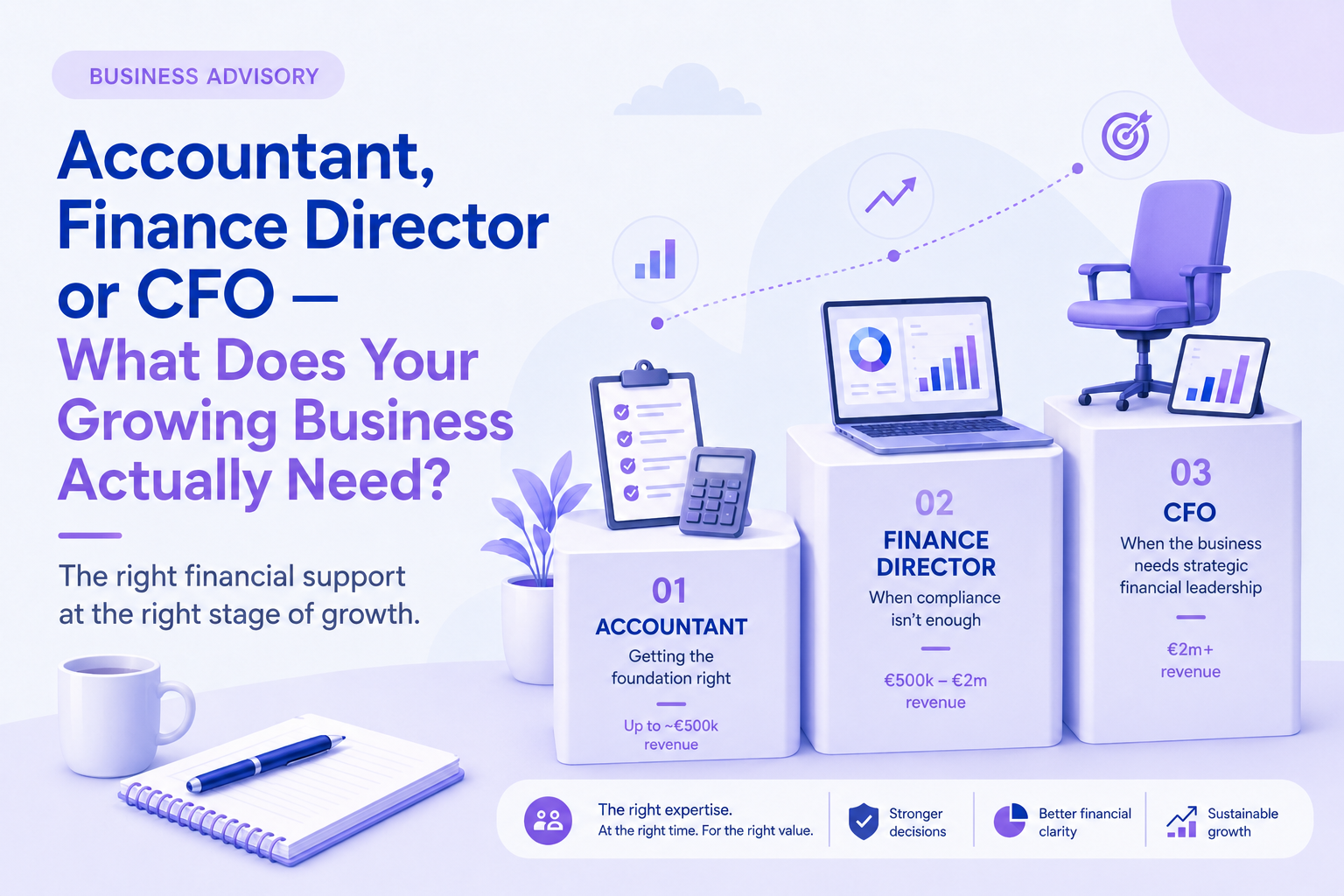
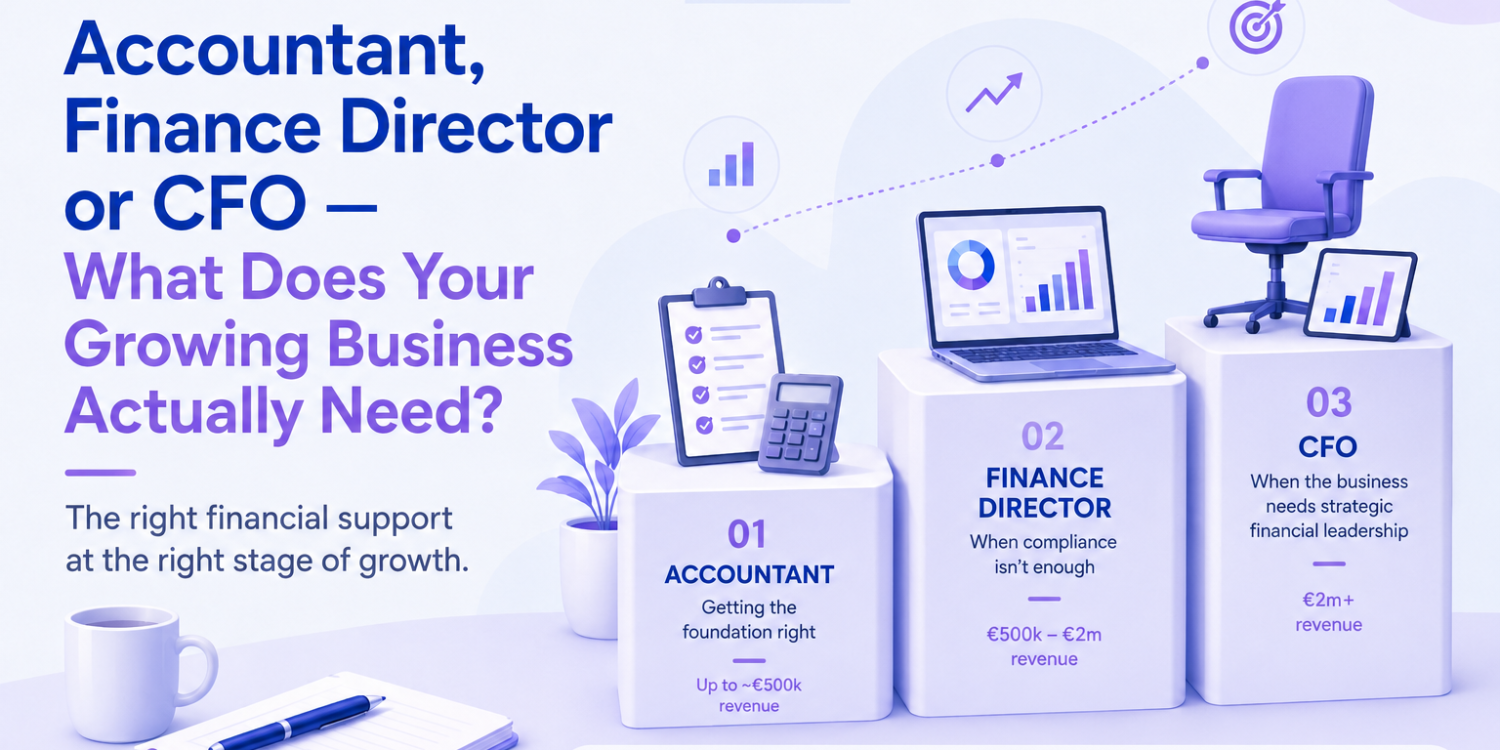
There are broadly three stages where the financial needs of a business change significantly.
The three stages
Stage 01. Getting the foundation right
Up to ~€500k revenue
At the early stage the primary financial need is accuracy and compliance. Accounts that are correct and current. Tax filed on time and correctly. VAT handled properly. Payroll running without errors.
This is what a good accountant delivers. Not a full-time employee — for most businesses at this stage, a qualified accountant working on a monthly retainer handles everything the business needs. The key word is good. An accountant who is proactive, responsive, and explains things clearly is genuinely valuable at this stage. One who files the accounts once a year and disappears for the other eleven months is not.
What the business doesn’t need at this stage is a finance director or a CFO. The complexity doesn’t justify it and the cost is disproportionate to the value. The priority is clean books, a clear tax position, and an accountant who tells the business owner what their numbers mean — not just what they are.
What you need: A good accountant on a monthly retainer
Stage 02. When compliance isn’t enough
€500k — €2m revenue
Something changes as a business moves through the €500,000 to €2 million revenue range. The decisions get bigger. Hiring decisions carry more financial weight. Pricing decisions have material consequences. Cashflow becomes more complex as the business takes on larger contracts, more customers, or more staff.
At this stage, the business still needs everything from stage one — accurate accounts, clean tax, correct payroll. But it needs something else as well. It needs someone who can look at the numbers and say: here’s what they mean for the next six months. Here’s what hiring two people does to your margins. Here’s whether the cashflow will support the investment you’re considering.
This is financial management rather than financial compliance. And it’s the gap that most growing businesses fall into — they have an accountant handling the compliance, but nobody looking forward.
A finance director in the traditional sense is a senior employee who owns the finance function — managing the accounts team, overseeing reporting, sitting on the management team. For most businesses at this stage, that’s more than they need and more than they can justify. A full-time finance director costs €80,000 to €130,000 per year before employer costs.
The more appropriate solution for most businesses in this range is a part-time or outsourced arrangement — someone with the capability of a finance director, available for the hours the business actually needs. Monthly management accounts, a rolling cashflow forecast, a regular review of the numbers, and someone to call when a significant decision needs to be made.
What you need: Outsourced financial management — part-time CFO level
Stage 03. When the business needs strategic financial leadership
€2m+ revenue
Above €2 to €3 million in revenue — or at any stage where the business is preparing for significant growth, raising investment, or navigating a complex financial situation — the financial support needs to evolve again.
At this stage the business needs someone who can do three things. First, ensure the financial reporting is accurate, timely, and appropriate for the stage of the business. Second, model the financial consequences of strategic decisions — growth scenarios, investment cases, pricing changes, new market entry. Third, represent the business credibly in financial conversations — with banks, investors, acquirers, or board members.
This is the CFO function. In a large business it’s a full-time senior executive role. In a growing SME it can be delivered through an outsourced arrangement — a CFO-level advisor who works with the business on a retained basis and scales their involvement as the business grows.
The simplest way to describe the distinction between a finance director and a CFO: a finance director manages the finance function. A CFO uses the finance function to inform the strategic direction of the business.
What you need: CFO-level strategic financial support — outsourced or full-time
The honest answer to the original question
Most growing businesses don’t need to choose between an accountant, a finance director, and a CFO. They need different things at different stages — and the most efficient way to access those things isn’t necessarily through a full-time hire at any stage.
A business at €300,000 in revenue needs a good accountant on a monthly retainer. A business at €1 million needs that accountant plus someone providing monthly management accounts, cashflow forecasting, and financial management. A business at €3 million and growing needs all of that plus CFO-level strategic input.
The question of whether to hire or outsource each layer depends on the volume of work, the budget, and the stage of the business. Full-time hires make sense when the work justifies them. Outsourced arrangements make sense when the business needs the capability without the overhead — which is most of the time, for most of the growth journey.
A practical framework
Before deciding what financial support the business needs, it’s worth being honest about three things.
What decisions is the business making that it doesn’t currently have the financial information to make well?
If the answer is significant — hiring, pricing, investment, borrowing — that’s a gap worth closing.
What does the current finance function actually deliver?
Is it compliance only, or does it include forward-looking financial management? If it’s compliance only and the business is growing, the gap is almost certainly already costing money.
What would change if the business had better financial visibility?
If the answer is meaningful — better decisions, faster growth, fewer cashflow surprises — the cost of improving the financial function is likely justified many times over.
THE BOTTOM LINEThe labels matter less than the capability. The question isn’t whether to hire an accountant or a CFO. It’s what financial support the business actually needs at its current stage — and whether it’s getting that support right now.
Most growing businesses aren’t. Not because they’ve made the wrong hire, but because the gap between what they have and what they need has quietly grown without anyone noticing.
Not sure what level of financial support your business actually needs right now? A free 30-minute Discovery Call is a straightforward way to find out. No pitch, no obligation — just an honest conversation about where the business is and what would actually help.
Book at accounto.ie or get in touch at hello@accounto.ie