Cloud Accounting and AI — What Actually Matters for Your Business and What Doesn’t
The noise around financial technology has become overwhelming. Most of it is irrelevant to a growing SME. Here’s what actually matters, what to ignore, and where to start.
If it feels like every conversation about technology and business has become overwhelming, that’s because it has.
Cloud accounting. AI-powered reporting. Automated bank feeds. Machine learning. Real-time dashboards. The language around financial technology has become so saturated with jargon and vendor enthusiasm that it’s increasingly difficult for a business owner to work out what any of it actually means for them — or whether it matters at all.
The honest answer is that most of it doesn’t. At least not yet, and not for most growing businesses.
But some of it does. And the businesses getting genuine value from technology right now aren’t the most sophisticated or the best resourced. They’re the ones who have been deliberate about what they adopted and why.
What cloud accounting actually is — and why it matters
Cloud accounting is accounting software that runs online rather than on a desktop computer. Xero, QuickBooks Online, and Sage Business Cloud are the main platforms used by SMEs. The data lives in the cloud rather than on a hard drive, which means it can be accessed from any device, shared with an accountant in real time, and connected to other business systems.
That connectivity is the important part. A cloud accounting platform connected to a bank feed means transactions flow into the accounts automatically rather than being entered manually. Connected to an expense capture tool like Dext, receipts photographed on a phone are automatically processed and categorised. Connected to Stripe or Shopify, sales reconcile automatically.
The result, when it’s set up correctly, is that the accounts are always current. Not at year-end. Not when the accountant asks for a bank statement. Now.
That matters because decisions — pricing, hiring, investment, borrowing — are better made with current financial information than with information that’s six months out of date. Most businesses still on desktop software or spreadsheets are making significant decisions with significantly stale data. The move to cloud accounting fixes that.
What it doesn’t do
Cloud accounting software doesn’t make decisions. It doesn’t tell a business owner whether they can afford to hire. It doesn’t identify a tax planning opportunity. It doesn’t flag that the gross margin has been declining for six months because material costs crept up while prices stayed flat.
It organises the data. The judgement still has to come from somewhere else — either from the owner themselves or from an advisor who understands the numbers well enough to know what they mean.
A lot of businesses adopt cloud accounting and then wonder why nothing has changed. The technology removes the friction from data collection and organisation. It doesn’t remove the need for someone who knows what to do with the data once it’s organised.
Where AI is genuinely useful right now
AI has become the most over-discussed and under-explained topic in business technology. It’s worth being specific about where it’s actually adding value for SMEs — because the realistic picture is both more modest and more practical than most of the coverage suggests.
Document processing and data extraction
AI is very good at reading documents — invoices, receipts, bank statements — and extracting the relevant data accurately and quickly. This is the technology behind tools like Dext, and it works well. What would take a bookkeeper an hour to process manually takes seconds. The accuracy is high and the time saving is real.
Cashflow alerts and anomaly detection
AI systems connected to cloud accounting data can monitor transactions and flag unusual patterns — a payment that looks like a duplicate, a supplier invoice that’s higher than previous ones, a cashflow projection heading toward a shortfall. These aren’t dramatic insights, but they’re consistent and they don’t require anyone to remember to check.
Financial report generation
AI can take structured accounting data and generate readable, narrative commentary — “revenue was up 12% on the prior month, driven primarily by the construction sector, while margins remained flat at 34%.” That kind of commentary used to take time to write. AI produces a first draft in seconds. A qualified accountant reviews and approves it before it reaches the client.
What AI is not doing well yet for most SMEsStrategic financial advice. Tax planning. Nuanced commercial judgement. Anything that requires understanding the context of a specific business rather than just the data it produces. These things still need a human — and probably will for some time.
The combination that actually works
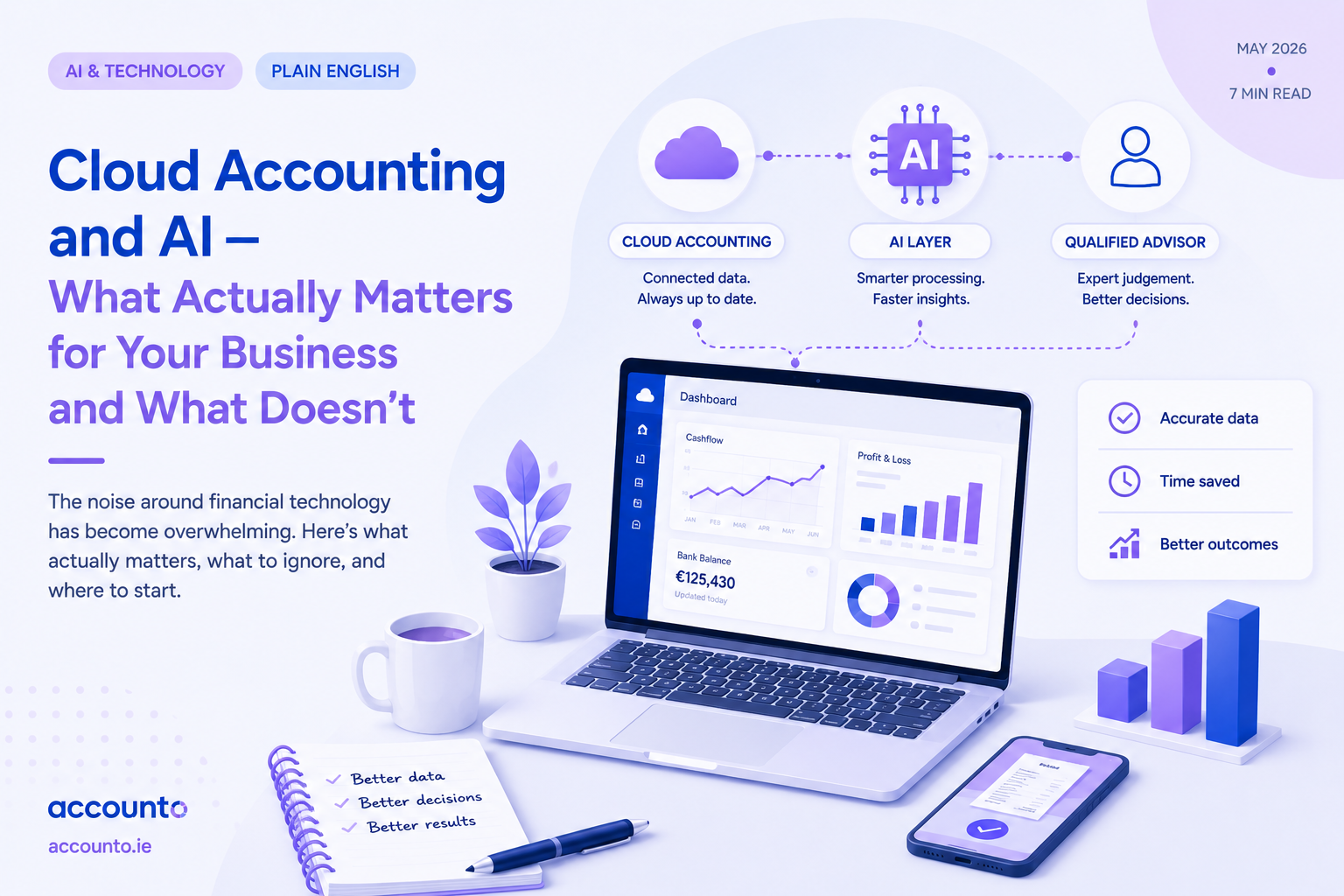
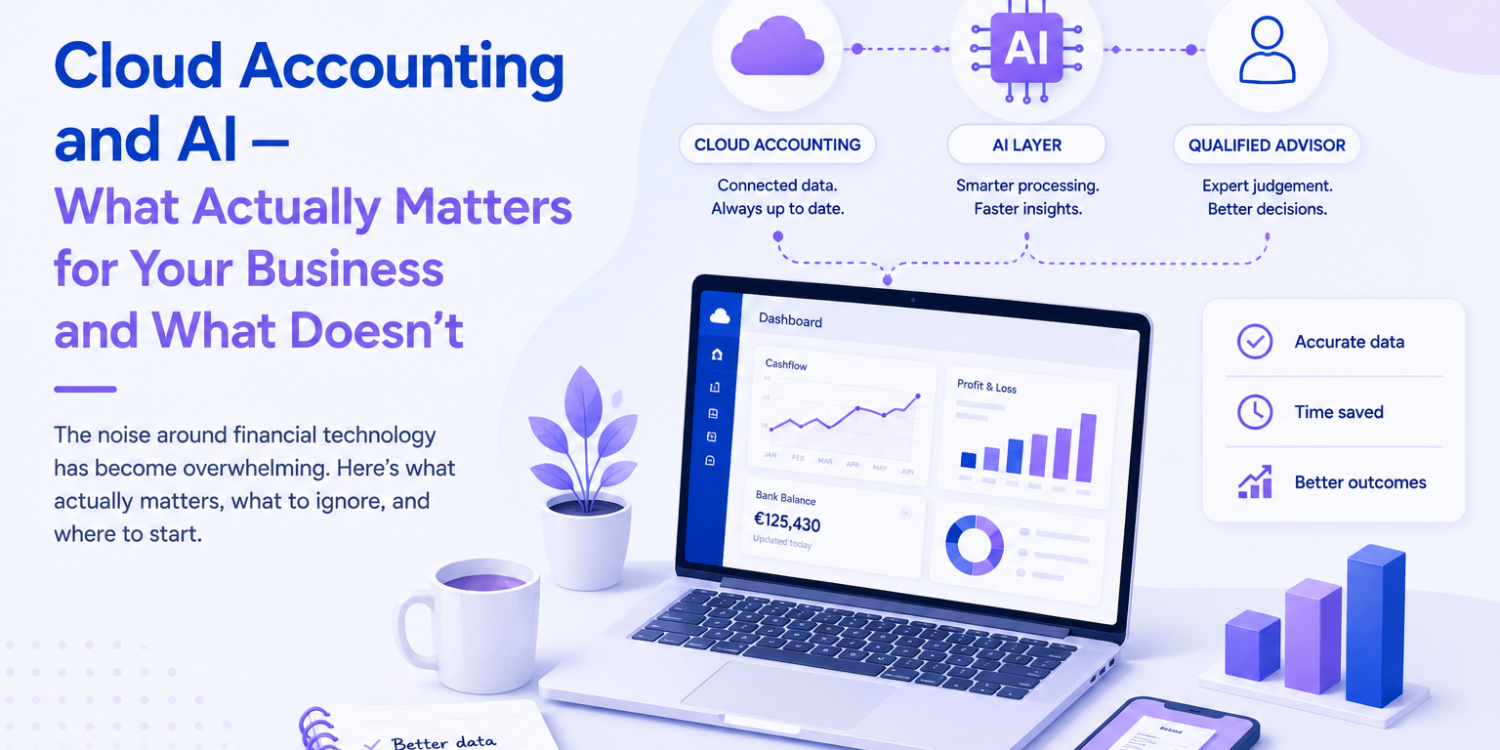
The businesses getting genuine value from financial technology are using it in a specific way. Three layers, working together.
Cloud accounting
Bank feeds, receipts, invoicing, reconciliation. The data infrastructure — clean, current, and connected.
AI layer
Document extraction, anomaly detection, first-draft reporting. Fast, consistent, tireless.
Qualified advisor
Tax planning, cashflow decisions, financial modelling. The judgement that actually changes outcomes.
Remove any one of those three layers and the value drops significantly.
Cloud accounting without good advisors gives an owner clean data they don’t know what to do with. AI without clean data produces unreliable outputs. And advisors without current data are working from a picture that’s already months out of date.
The technology isn’t a replacement for expertise. It’s what makes expertise more efficient, more timely, and more accessible than it would otherwise be.
The practical question for most business owners
The relevant question isn’t “should I be using AI?” It’s simpler than that. Before any technology conversation, it’s worth being honest about three things.
Three questions worth asking right now
- Are the accounts current right now — or is the last set of numbers six months old?
- Does the business have visibility into its cashflow position today — not at year-end?
- When a significant financial decision comes up, is there current data to inform it — or is it instinct?
If the answer to any of those is no, the starting point isn’t AI — it’s moving to cloud accounting and getting the data infrastructure right. Everything else builds on that foundation.
Once the foundation is right, the technology that sits on top of it — automated reporting, cashflow alerts, AI-assisted commentary — starts to add genuine value. Before that, it’s a solution to a problem that doesn’t exist yet.
THE BOTTOM LINECloud accounting and AI are useful. They’re not magic. The businesses that benefit from them most aren’t the ones that adopted the most tools — they’re the ones that adopted the right tools for the right reasons, built the foundation before adding the complexity, and kept a qualified human in the loop for the decisions that actually matter.
If the accounts aren’t current, the numbers aren’t visible, and financial decisions are being made on instinct rather than data — the technology conversation can wait. That problem is worth fixing first.
Want to understand what the right financial setup looks like for your business right now? A free 30-minute Discovery Call is a straightforward starting point.
Book at accounto.ie or get in touch at hello@accounto.ie